
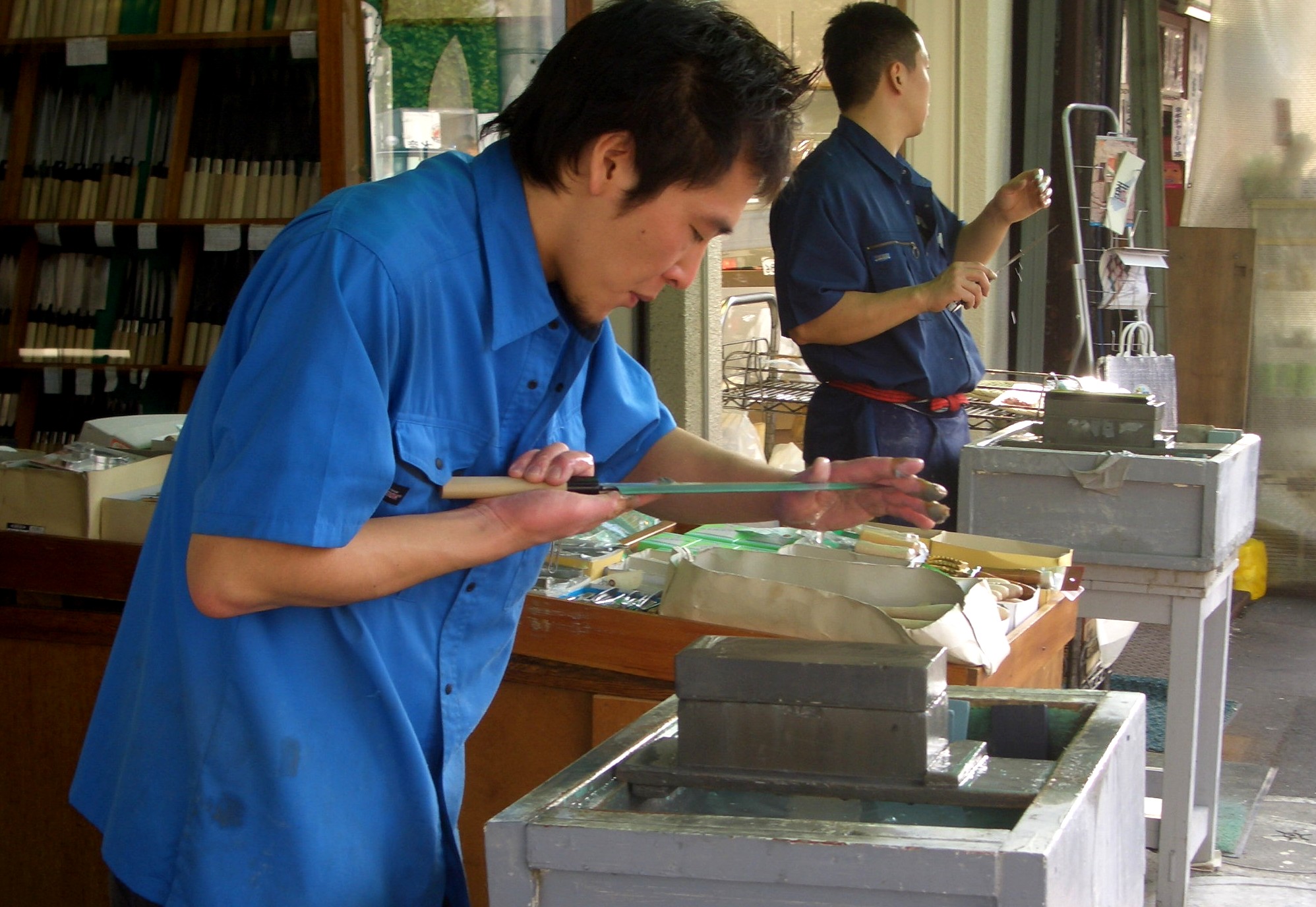
The burr is useful evidence. It is also a tiny wire gremlin. Do not leave it in charge.
First sharpening setup
Skip buying more gear until burr formation, pressure and deburring make sense.
The whole game is the apex
A sharp edge is where two bevels meet cleanly. Sharpening removes steel until those bevels meet again at the apex. That is the entire plot. Everything else is angle control, pressure control, stone choice and burr management.
Beginners often chase shiny bevels instead of clean apexes. Shiny is nice. Sharp is better. If the knife still slides on tomato skin, the apex is not finished no matter how cinematic the bevel looks.
Angle: consistent beats perfect
You do not need to know whether you are at 14.7 degrees. You need to hold a stable angle for the knife in front of you. Western stainless workhorses can tolerate a slightly wider angle. Thin Japanese stainless and carbon knives usually want a cleaner, lower angle but not abuse-level thin.
Pick an angle, lock your wrist, use the height of your spine as a repeatable cue, and slow down. Speed is what happens after consistency, not before.
Pressure: heavy to light
Start with enough pressure to make progress, then reduce pressure as the apex forms. If you keep grinding with heavy pressure after the burr appears, you are not being thorough; you are making cleanup worse.
Use water as the stone requires and let the abrasive do the work. Wusthof notes that water and released particles form slurry on a whetstone. That slurry is useful. Your biceps are not the sharpening system.
Burr, deburr, test
Raise a burr along the full length of one side, then the other. Then reduce pressure and remove it. Deburring is where many decent sharpening sessions become mediocre edges. A burr can feel sharp for five minutes and then fold over like a bad lawn chair.
Test gently on paper, tomato skin or thumbnail feel if you know what you are doing. Do not saw aggressively through printer paper and call it science. The edge should bite cleanly and predictably.
The first setup
For most home cooks, a 1000 grit stone, a 3000 grit refinement option and a simple strop are enough. Add a flattening method when the stone starts dishing. Add coarse stones only when you need repairs or thinning.
Natural stones are a separate hobby. Fun, beautiful, occasionally wallet-hostile. Start synthetic, learn feedback, then wander into the swamp with a trusted seller if you still hear the stones calling.
Takeaways
- Sharpening forms a clean apex.
- Consistency matters more than exact angle numbers.
- Deburring is not optional. It is the difference between sharp and temporarily convincing.
Relevant links
Affiliate links may earn commission. Check the exact listing, size and seller before buying.
A compact setup for stainless gyuto, nakiri and Western chef knives: 1000 for the edge, 3000 for tidy refinement.
Check current priceFor removing the last clingy burr. Helpful, cheap, and less dramatic than buying another knife at midnight.
Check current priceKeeps your stone flat enough to make a flat-ish bevel. Dished stones teach bad habits.
Check current priceA gentle board protects thin edges better than glass, stone, bamboo punishment slabs or chaos.
Check current price