
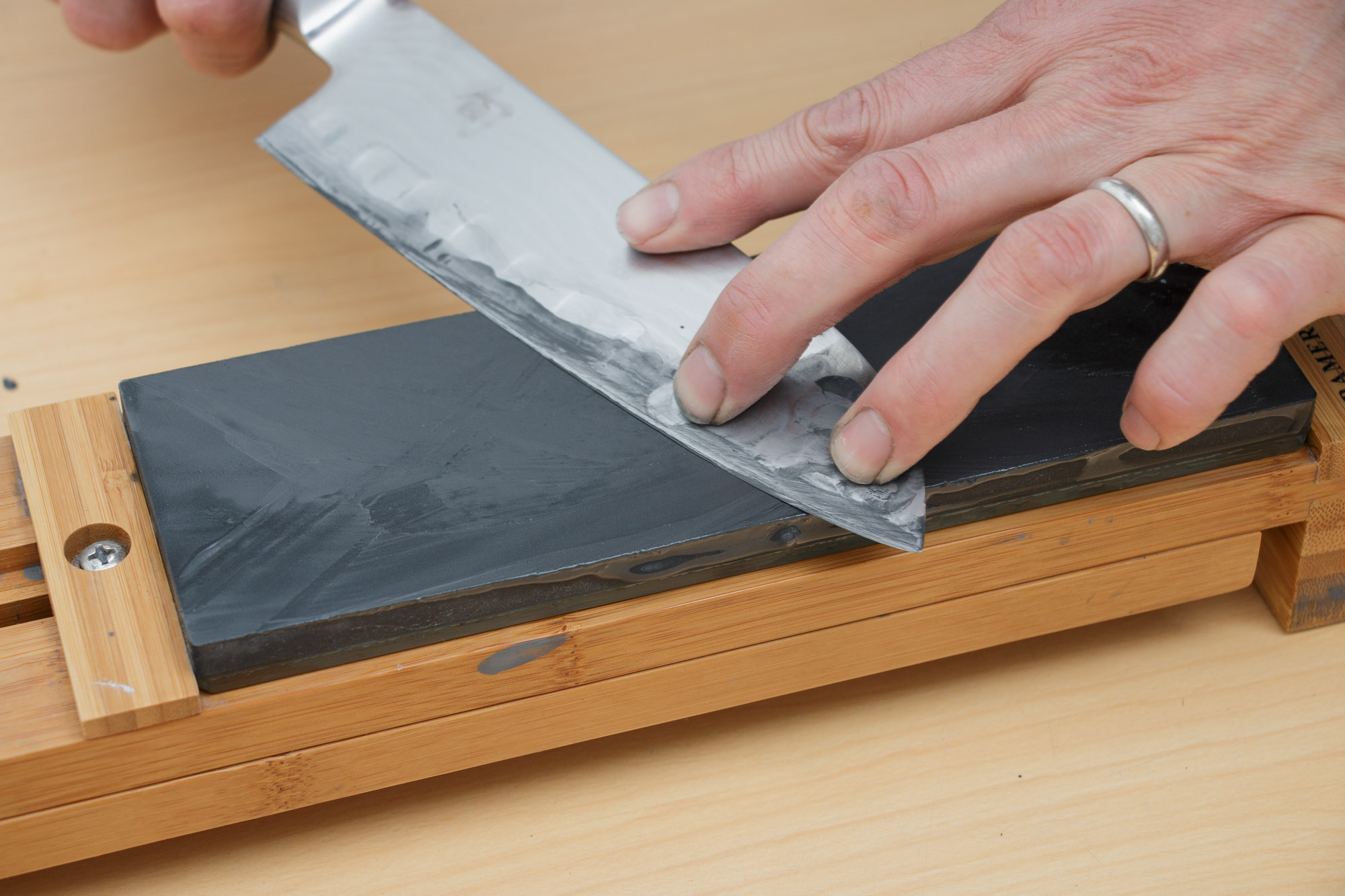
The best first stone is the one you will actually use before the knife becomes a butter spreader with ambition.
First sharpening setup
Skip buying more gear until burr formation, pressure and deburring make sense.
Start at 1000-ish grit
Most kitchen knife sharpening starts around 800 to 1200 grit. That range is coarse enough to make a real edge and fine enough that you are not panic-grinding your knife into a letter opener. If you only own one stone, make it this middle stone. The rest of the kit can wait outside like a polite dog.
King and Shapton are common names because they solve this first-stone problem in different ways. King is the soft, classic, forgiving waterstone lane. Shapton is the harder, faster, splash-and-go ceramic lane. Neither is magic. Both can produce sharp kitchen edges if your angle, pressure and burr removal are sane.
King: slow enough to teach you
King stones, especially the common 1000 and 1000/6000 directions, are popular because they are accessible and give clear feedback. They tend to feel softer and muddier than Shapton. Beginners often like that because the stone tells you something through sound and feel. It feels like sharpening, not like skating a knife across a ceramic tile.
The downside is maintenance. Softer stones dish faster. If the stone stops being flat, your bevels get rounded and your results become weird. A King stone is a good teacher, but it also teaches the lesson called flatten your stone, you coward. You do need a flattening plan eventually.
Shapton: less ritual, more bite
Shapton Kuromaku/Pro stones are popular because they cut quickly, wear slowly and do not require a long soak. Splash water, sharpen, rinse, dry. This matters for home cooks because a stone that is easy to start is a stone that gets used before the knife becomes awful.
The feel is harder and less muddy than King. Some beginners love that because it feels precise. Others find it less communicative at first. That is not a flaw; it is a personality. The Shapton 1000 also behaves a little coarser in feel than some softer 1000 stones, which can be useful for dull stainless workhorses.
The actual buying logic
Buy King if you want value, feedback and a forgiving practice surface, and you accept soaking and flattening. Buy Shapton if you want low setup friction, fast cutting and a stone that dishes more slowly. If you are the kind of person who forgets to soak beans, you may also forget to soak stones. Self-knowledge is a sharpening accessory.
For a low-fuss VG10 nakiri or stainless gyuto, I would lean Shapton 1000 plus a strop, or King 1000/6000 if budget is tighter and you like the idea of a combo stone. Do not buy a 6000 stone because the number looks more premium. The 1000 side does the actual sharpening. The fine side refines an edge that already exists.
What to add after the first stone
First add a way to flatten the stone. Diamond plate, lapping plate, flattening stone: choose a real solution. A dished stone quietly ruins the work. Second add a strop or simple deburring block. Most beginner edges fail at the burr-removal step, not the grit-selection step.
Only add a 3000 to 6000 stone after your 1000 grit edge is consistently sharp. A high-grit stone is not a shortcut. It is polish on a result you already earned. Buying polish before burr control is like buying shoe cream for feet you have not yet found.
Verdict
King is the patient teacher. Shapton is the efficient colleague who already opened the spreadsheet. Both are good. The mistake is buying either one and then never learning pressure control, burr formation, deburring and flattening.
My default recommendation: Shapton 1000 for low-fuss home cooks; King 1000/6000 or King Deluxe 1000 for people on a tighter budget who want more feedback. Add a strop and flattening plate before you start browsing exotic stones at midnight.
Takeaways
- Start with one medium stone around 1000 grit.
- King is softer, feedback-rich and budget-friendly, but needs soaking and flattening discipline.
- Shapton is harder, faster and splash-and-go, with less muddy feedback.
- Add a strop and flattening method before buying lots of high-grit stones.
- A polished dull edge is still dull. The 1000 grit edge must work first.
Relevant links
Affiliate links may earn commission. Check the exact listing, size and seller before buying.
Budget-friendly starter direction: 1000 for sharpening, 6000 for refinement after the edge is already sharp.
Check current priceClassic medium-grit waterstone direction with clear feedback. Add a flattening plan.
Check current priceSplash-and-go ceramic stone direction for low-fuss home sharpening.
Check current priceKeeps the stone flat so the bevel does not become a rounded mystery.
Check current priceHelpful for burr cleanup after stone work. Use very light pressure.
Check current price