
Pattern is allowed. The food still gets final approval.
Visual drama backed by real forging culture
Skip buying by name alone. Read dimensions, grind notes, steel, retailer measurements and owner context first.
Why this maker matters
Nigara matters because it challenges the idea that serious knives must be visually quiet. Public maker and retailer material connects Nigara to a long Tsugaru sword-making tradition in Hirosaki, while also presenting a modern workshop interested in original Damascus and younger craftspeople.
In Adrichops terms, the useful question is not whether Nigara Hamono is hyped. The useful question is what the maker teaches about how Japanese knives work: profile, grind, steel, sharpening, board contact and maintenance. The story is only valuable if it changes how you choose and use the tool.
Region and workshop reality
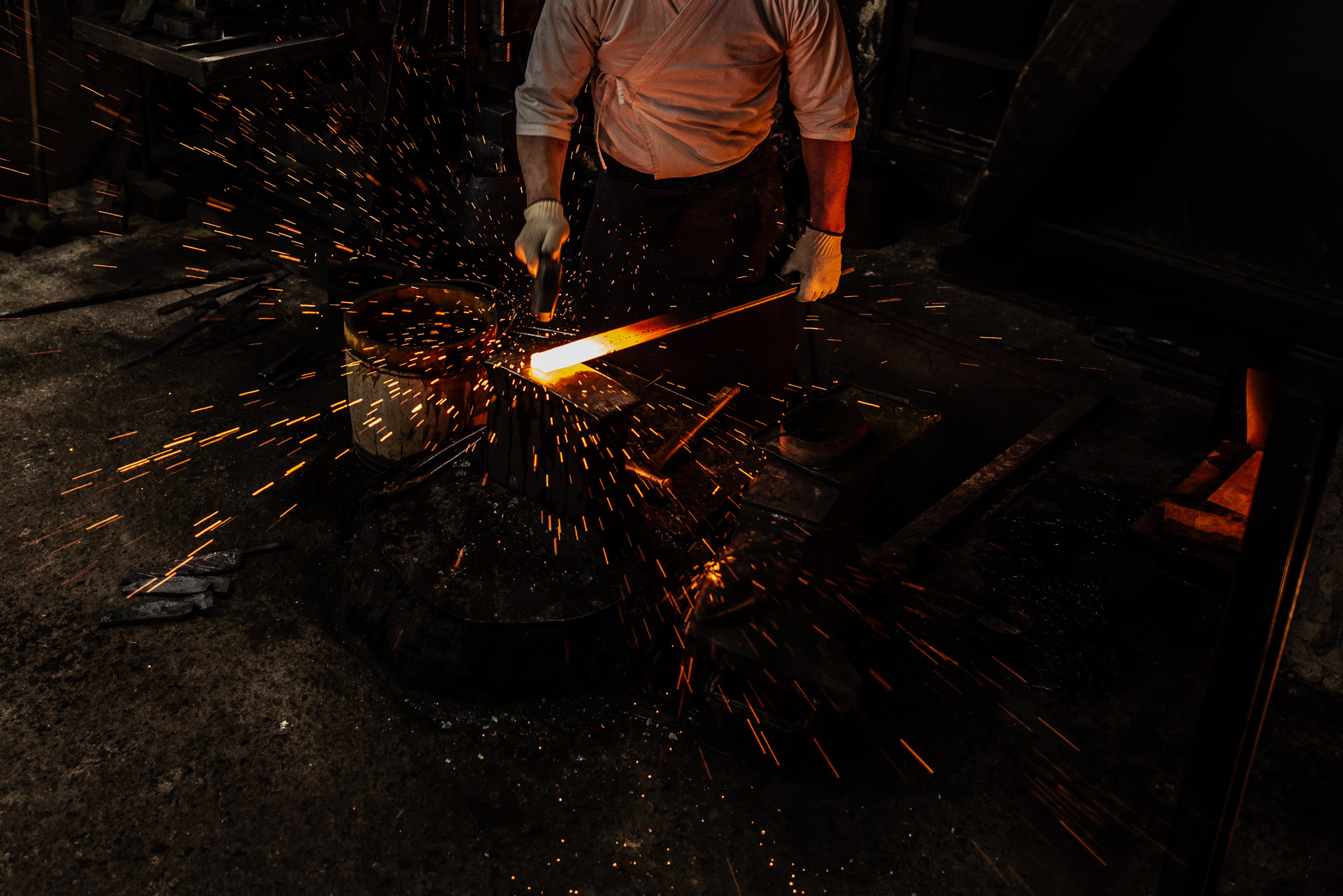
Region: Hirosaki, Aomori / Tsugaru tradition. Known for: long Tsugaru lineage, original Damascus, Anmon-style visual work. That short line matters because Japanese knife regions carry different habits. Sakai, Sanjo, Kochi, Aomori and Kumamoto do not all make the same kind of object with different stamps.
The current Nigara story is not just old lineage. It is old lineage trying new visual language. Official material from Nigara highlights a new generation and the reward of creating original Damascus steel. That combination makes the brand more interesting than “pretty pattern, buy now.”
When reading maker pages, treat the workshop story as context rather than proof. A great story can explain why a knife exists; it cannot replace choil photos, measurements, sharpening behaviour or whether the thing suits your prep board. Beautiful provenance still has to pass through a carrot.
Cutting character
Nigara knives vary by line, but the practical test is always the same: does the geometry support the visual ambition? A beautiful blade with poor thickness behind the edge is just expensive scenery. A good Nigara gives you the pattern and still behaves like a proper kitchen tool.
The trade-off is distraction. Damascus, Anmon and other blade faces can make buyers forget to check height, weight, grind, balance and steel. The finish may sell the knife, but the cross-section cooks the onion.
The practical test is always boring in the best way: onions, carrots, potatoes, herbs, protein trimming and repeat prep. Knife people can make any blade sound poetic, but food tells the truth quickly. If a knife wedges, sticks, feels unstable or scares you away from using it, the spec sheet has lost the argument.
Steel and construction without the fog machine
Common steel conversation: VG10, SG2/R2, Aogami, Damascus and line-specific patterned steels. Steel is important, but it is not the whole knife. Heat treatment, grind, edge geometry and sharpening quality decide whether the steel becomes useful or just a word in a product title.
Nigara appears in VG10, SG2/R2, carbon and other constructions depending on line. Stainless or powdered stainless lines are more practical for low-fuss owners. Carbon and iron-clad versions bring patina and care. The pattern does not decide the maintenance routine; the steel does.
For normal cooks, the decision is usually stainless convenience versus carbon feedback. Stainless and semi-stainless steels reduce care anxiety. Carbon steels often sharpen beautifully and develop patina. Neither path is morally superior. The best steel is the one that matches your sink habits, stone habits and tolerance for wiping blades during prep.
How I would shop it
Shop by profile first, steel second, pattern third. If you want a daily knife, a stainless or SG2 gyuto or bunka may be the cleanest route. If you want carbon drama and accept care, go deeper. Ask for choil shots because a dramatic blade face can hide boring problems.
Before buying, ask five plain questions: what food will this cut most often, what board will it hit, what maintenance can I actually sustain, who made and sharpened it, and does the exact listing show enough detail? If the answer is mostly vibes, wait.
The best retailers make the decision easier by showing choil, spine, heel, handle and blade-face photos. They also give measurements and steel details without making you hunt through decorative adjectives. A knife page should help you cook better, not simply make the buy button glow.
Red flags
The red flag is buying beauty while ignoring fit. If the handle, height or balance is wrong, the knife becomes a decorative compromise. Another red flag is being afraid to scratch it. Functional art has to survive contact with dinner.
Also beware of the phrase “for life” when it is used to avoid specifics. A knife can last for decades if it is used correctly, sharpened properly and not abused. It can also chip in five minutes if you twist a hard edge through something stupid. Longevity is a relationship, not a warranty spell.
Board, stone and maintenance pairing
Pair Nigara with a board that respects the edge and stones matched to the steel. SG2 likes efficient ceramic stones; carbon can feel excellent on softer stones. Do not use the blade face as a reason to avoid sharpening. Edges are consumables.
The safe baseline is simple: edge-friendly board, hand wash, dry immediately, store safely, touch up before the knife becomes truly dull. Add a strop if you know how to use it lightly. Add a flattening plate if you use waterstones. Remove rust early rather than waiting for the blade to develop a small weather system.
For most home cooks, a 1000 grit stone is the centre of the universe. A 2000-3000 grit finisher is nice once your deburring is clean. Higher polish can be fun, especially for certain Japanese steels, but it is not a substitute for angle control. The burr is where ego goes to get exposed.
Where it sits in Japanese knife culture
Nigara belongs in the culture map because it shows that Japanese knife making is not frozen in a minimalist past. There is room for bold pattern, heritage, export demand and real kitchen use in the same object.
This is also why Adrichops treats maker spotlights as buying education, not celebrity worship. Japanese knives are made by people and systems: smiths, sharpeners, polishers, handle makers, retailers and users. Appreciating the craft should make your use more careful, not make the knife untouchable.
Adrichops take
Nigara Hamono is worth studying because it adds a specific lesson to the knife map. Some makers teach thinness, some teach workhorse geometry, some teach steel care, some teach branding and collaboration. The point is not to collect names. The point is to learn what each name tells you to look for.
The simple rule: buy the knife that fits your food, your board, your sharpening and your level of care. Then use it. Functional art is allowed to get wet, develop patina, earn scratches and come back from the stone sharper than before. That is the whole deal.
For a maker spotlight, the end goal is not a verdict that sounds final. It is a better set of questions for the next purchase, the next sharpening session, and the next meal. If the article makes you look twice at geometry before clicking buy, it has done its job.
Takeaways
- Do not buy Nigara Hamono by name alone; match the exact knife to food, board and care habits.
- Use source trails, retailer measurements and forum owner notes to understand the line before buying.
- Treat maker appreciation as a reason to use and maintain the knife, not to make it untouchable.