
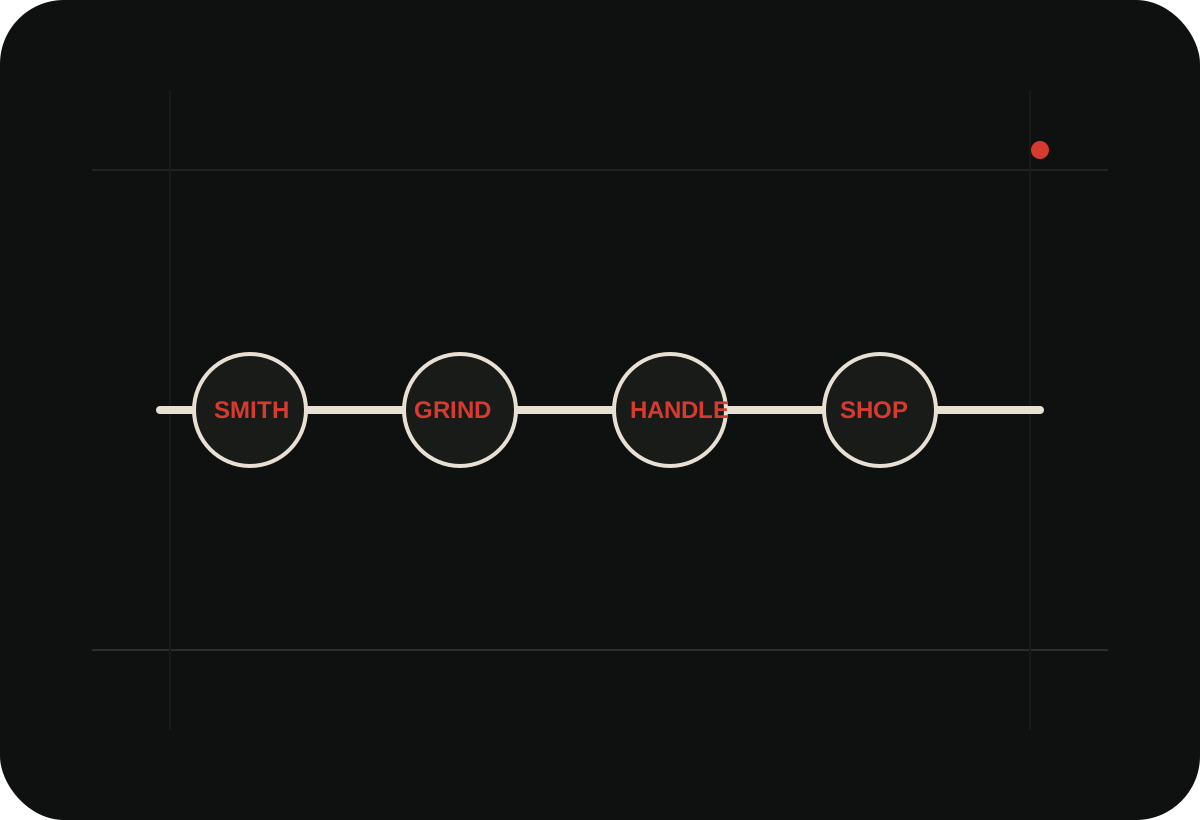
A sharpener lineage is a map of tendencies, not a receipt for how every individual knife will cut.
Understanding Sakai wide bevel sharpening lineages
Skip if you want mythology. This note is meant to be practical and source-aware.
Why this thread matters
The useful part of the Reddit deep dive is not that it crowns one sharpener forever. The useful part is that it puts four related Sakai wide bevel examples next to each other and treats the sharpener as a major part of the knife, not a footnote.
The comparison uses four owned gyuto examples: a Tanaka x Morihiro Kagekiyo, a Tanaka x Nishida Kagekiyo, a Tanaka x Kyuzo example, and a Nakagawa x Tadokoro example. The author also gives the important warning up front: these are handmade knives, variance exists, and the post should be read as a guide, not as a fact sheet. That is exactly the right way to use community material.
For Adrichops, this thread is useful because it sharpens the maker map. Morihiro is not just a famous name. Morihiro becomes a reference point for a small set of sharpeners and finishes that buyers keep running into when they read Sakai listings.
Morihiro as the reference point
Morihiro sits in the graph as a Sakai sharpener with two different kinds of importance. First, there is direct work: older Konosuke Fujiyama context, Kagekiyo examples and collector discussion where the name itself matters. Second, there is lineage: Nishida, Tadokoro and the Kyuzo/Yauchi trail are often discussed in relation to Morihiro-style wide bevel work.
The Reddit post describes all four knives as Sakai wide bevels sharpened by Morihiro or one of his students. That does not mean they all cut the same. It means the comparison is close enough that small differences become meaningful: shoulder shape, concavity, taper, tip thinness, food release, profile and finish.
That is the real lesson. Once knives are all good, the buying question shifts from good versus bad to which compromise you want. A little more food release may come with a different shoulder. A more aggressive hollow can feel thrilling through dense food and less forgiving elsewhere. A stronger tip may feel less needle-like. None of that fits into a simple ranking.
Nishida: the balanced Kagekiyo branch
The thread is especially useful for Nishida because it describes a Tanaka x Nishida Kagekiyo as sitting between confidence and performance. The post frames Nishida as having the thin, high-performance feeling expected from this class of Sakai wide bevel, while still retaining enough balance and taper to feel natural across different prep tasks.
That matches why Nishida belongs in the graph as more than a loose Baba Hamono note. Nishida is a named sharpening context for Kagekiyo, and the relationship matters when comparing one Kagekiyo to another. Same brand, similar smith trail, same broad Sakai world, but the sharpener can still change the experience.
The practical buying rule is simple: if a listing says Nishida, do not stop reading. Look for steel, measurements, profile, choil, spine, bevel photos and handle. Nishida is a strong clue, not the whole knife.
Kyuzo, Yauchi and the Myojin/Izo correction
The Reddit thread uses Yauchi/Kyuzo language. The Adrichops graph now keeps Kyuzo/Yauchi separate from Naohito Myojin because Myojin is Izo, not Kyuzo. That distinction matters: otherwise the graph would collapse two different naming trails and make the map less useful.
The thread's useful observation is still worth capturing. The Kyuzo example is described as the more extreme performance side of the comparison: wider bevel, more pronounced hollow, stronger shoulders, very high cutting performance, and less food release or toughness than the sturdier examples.
That does not mean every Kyuzo-labeled knife will be identical. It means that when you see Tanaka x Kyuzo, Nakagawa x Kyuzo or Togashi x Kyuzo, the right question is not just who forged it. The right question is what the sharpener did to the bevels and how that exact line is built.
Myojin/Izo belongs in a different branch of the map. Myojin still matters enormously for polishing and finishing, especially around Myojin Riki Seisakusho and Tetsujin-style buying conversations, but it should not be used as a synonym for Kyuzo in this site.
Tadokoro: the sturdier wide bevel lesson
Tadokoro is useful because the thread does not describe it as simply another Morihiro-style copy. The Tadokoro example is framed as more convex and sturdier, with better food release and a different tip shape. That makes it less of a pure thinness contest and more of a practical kitchen choice.
This matters because people often talk about wide bevels as if thinness is the only virtue. It is not. Food release, tip confidence, board feel, profile and how forgiving the knife feels during repeated prep all matter. A knife can be a slightly less dramatic cutter and still be the one someone should choose for actual cooking.
In the graph, Tadokoro should stay connected to Morihiro student-lineage context, but it also deserves its own sharpener/collaboration identity. A Nakagawa x Tadokoro Ginsan is not the same buying question as a Tanaka x Morihiro Kagekiyo.
What Morihiro seems to combine
The owner comparison describes the Morihiro example as if it pulls useful traits from the others: Nishida-like taper and tip feeling, Tadokoro-like shoulder softness and release, and Kyuzo-like wide bevel cutting intensity. That is exactly the kind of community observation that is useful, as long as it remains tied to the actual knife being discussed.
The broader lesson is that master status should not be treated as magic. If Morihiro is a reference point, it is because the work gives people specific things to notice: shinogi execution, spine and choil finishing, tip behaviour, bevel transition, cutting feel and food release.
Those are observable features. They are better than just saying "legendary" and stopping there.
How to use this when buying
When reading a Sakai wide bevel listing, start with the chain. Who forged it? Who sharpened it? Who finished it? Which brand or retailer specified the line? Is the steel reactive or stainless? Are the photos and dimensions good enough to understand the grind?
Then use lineage as a hypothesis. Morihiro may suggest a reference style. Nishida may suggest a Kagekiyo sharpening path with strong balance and taper. Kyuzo/Yauchi may suggest a more aggressive high-performance wide bevel. Tadokoro may suggest a sturdier or more food-release-aware interpretation. But none of those guesses should override the exact listing.
Community posts are best used as pattern recognition. They help you ask better questions. They should not make you stop asking questions.
What changed in the maker map
The maker graph now treats the Reddit thread as a specific source trail for Morihiro, Nishida, Tadokoro and the Kyuzo/Yauchi node. It also adds a Morihiro-to-Kyuzo/Yauchi lineage edge and keeps Myojin/Izo separate.
That is deliberate. The map should show the relationship because buyers discuss these knives this way. It should also show the caveat because exact attribution matters.
The clean version is this: Morihiro is the reference point; Nishida, Kyuzo/Yauchi and Tadokoro are useful related trails; Myojin/Izo is a separate polishing trail; the exact knife still decides the truth.
Takeaways
- Morihiro is useful as the reference point because the thread compares him directly against sharpeners framed as students or lineage branches.
- Nishida, Kyuzo/Yauchi and Tadokoro should not be treated as interchangeable; the owner comparison describes different trade-offs in taper, shoulders, food release and delicacy.
- The Reddit post is valuable owner context, but it is not official biography or a universal spec sheet for every knife from those sharpeners.