
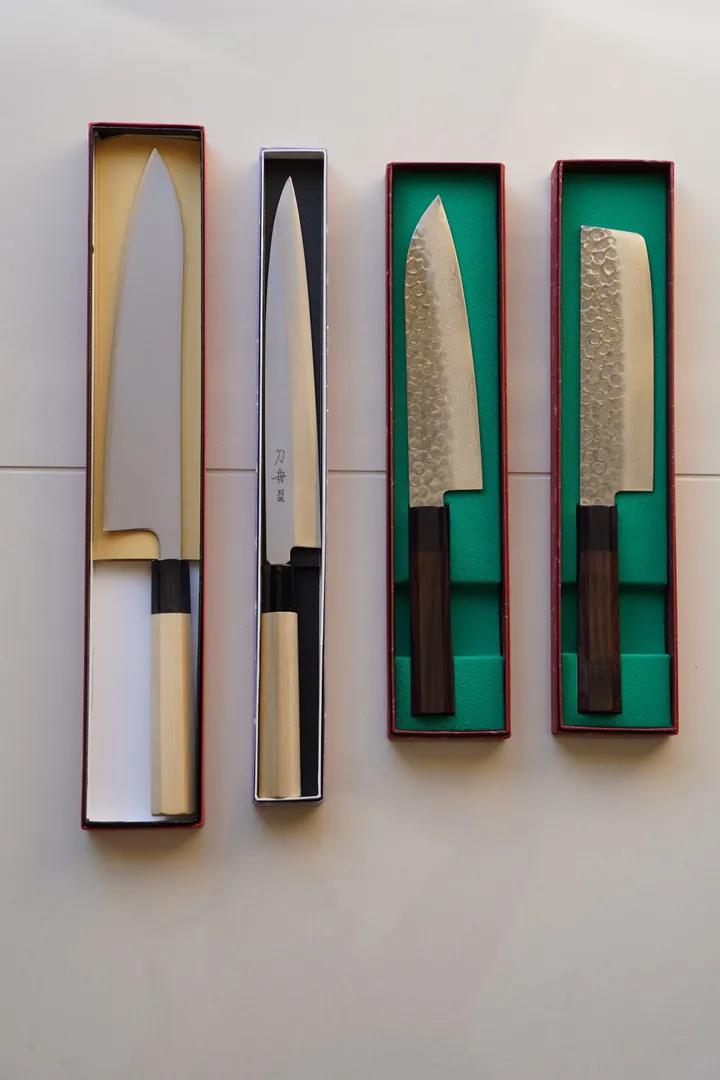
Start with the work, not the wall of knives
The useful home kit is smaller than the internet wants it to be: one main knife, one small knife and one serrated knife. That can be an 8 inch chef knife or 210mm gyuto, a petty or paring knife, and a bread knife. Everything else should be a response to a real cooking habit, not a display-case daydream.
This is also the safest way to spend affiliate money honestly. A reader who chops onions twice a week does not need a seven-knife block. A reader who preps vegetables every day might deserve a nakiri before a prestige German chef knife. Shape first. Flex later.
The profiles in plain English
A Western chef knife is the forgiving workhorse: curved belly, familiar handle, usually enough weight to feel stable. A gyuto is the Japanese all-purpose equivalent: often thinner, lighter and calmer through vegetables. A santoku is shorter and compact. A nakiri is a flat-edged vegetable rectangle, and I say rectangle with respect.
Petty knives live on the board for lemons, shallots and trimming. Paring knives work in the hand. Bread knives do crust, tomatoes and anything that punishes a plain edge. Boning knives, fillet knives, slicers and cleavers are great when the job is specific. Choose a specialist knife when you regularly do its intended job.
Steel is not the first question
Steel and construction affect care requirements. A stainless knife still needs washing and drying; a carbon-steel edge also needs wiping during use and closer attention to moisture. Neither steel type alone establishes cutting feel.
Before steel, ask: how do I cut, what board do I use, how often will I sharpen, and will anyone put this in the dishwasher when I am not looking? That last question has ended many romantic purchases.
The Adrichops buying rule
For this site, the review format is simple: state the source, state whether it is hands-on or a research brief, then explain the maintenance kit that makes the knife make sense. No copied Amazon star counts, no static prices, no borrowed product photos pretending to be experience.
Where I have personal experience, the notes identify it. Other recommendations use published product information and should be read as researched guidance.
Takeaways
- Buy the shape for the work you actually do.
- For low-fuss vegetables, a stainless santoku or nakiri is often more useful than a prestige chef knife.
- Pair every knife recommendation with a board, stone and storage answer.