
Start with tonight's dinner
Think about the food you cook most often. Onions, herbs, boneless chicken and vegetables usually ask for the same thing: one comfortable, sharp everyday knife. I would spend time using that knife before buying a block full of specialist shapes.
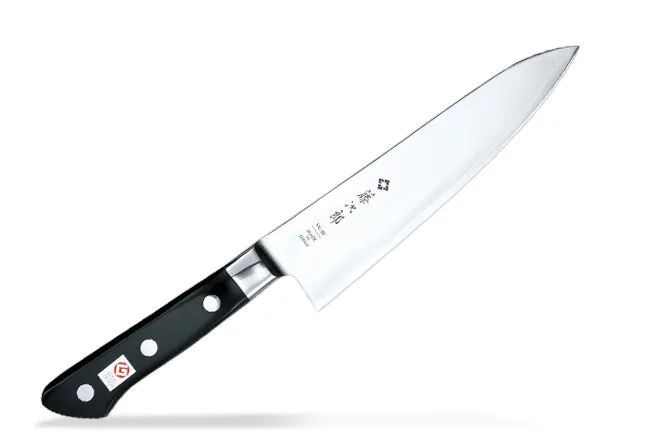
My own starting point was a Tojiro DP gyuto. I used it as a line cook and kept cooking with it afterwards. That experience shapes my recommendations, but it does not mean everyone needs the same knife.
Two sensible starting points
The Victorinox Fibrox extra-wide 20 cm chef's knife is my value recommendation. Its practical grip and stainless blade make it an approachable everyday choice. Some shops call it a carving knife, so check the extra-wide blade and model rather than relying on the listing title alone.
The Tojiro F-808 is my recommendation for someone who wants a first Japanese gyuto. Tojiro now lists it as the Classic Chef Knife 210 mm; you will also see the DP name at retailers. The VG10 core and stainless cladding belong in an everyday kitchen, but the edge still deserves controlled cutting. Avoid bones, frozen food and twisting inside hard ingredients.
On my Tojiro, the unfinished spine could become uncomfortable during long sessions. I would check grip comfort before buying, especially for extended prep.
I would choose between them on comfort, budget and how I cut. A familiar knife used well is more useful than an expensive one I hesitate to pick up.
Buy the second knife for a real job
If you eat crusty bread, a Victorinox serrated bread knife earns its place. If you peel fruit in your hand, an inexpensive paring knife is useful. Neither needs to match your chef's knife.
A tall Chinese vegetable slicer can be an excellent choice for someone who likes that shape. Check that it is intended for slicing vegetables and boneless food. A heavy bone cleaver is a different tool.
Keep the board simple
Use a stable wood or food-grade plastic board with enough room for your ingredients. Make sure it fits your sink. An expensive rubber board is an optional upgrade, not a prerequisite for a good knife.
A blade guard is a modest addition if the knife lives in a drawer. Measure it first, and put the knife away clean and dry.
One stone, then practice
When you are ready to sharpen, I would start with King Deluxe 1000 for value or Shapton Kuromaku 1000 for convenience. Both give you a medium-grit starting point.
Follow the exact stone's instructions. Shapton's guidance includes brief preparation before the first use; normal use does not require a long soak. Keep the stone stable, learn to remove the burr and keep its surface flat as it wears.
A strop, fine finishing stone and second chef's knife can wait. The next useful purchase should come from a problem you have noticed while cooking.
Takeaways
- A single everyday knife covers most board work.
- Victorinox is my value starting point; Tojiro is my first Japanese-knife recommendation.
- Add a bread knife or paring knife when those jobs call for one.
- Learn on one medium stone before buying finer grits.