
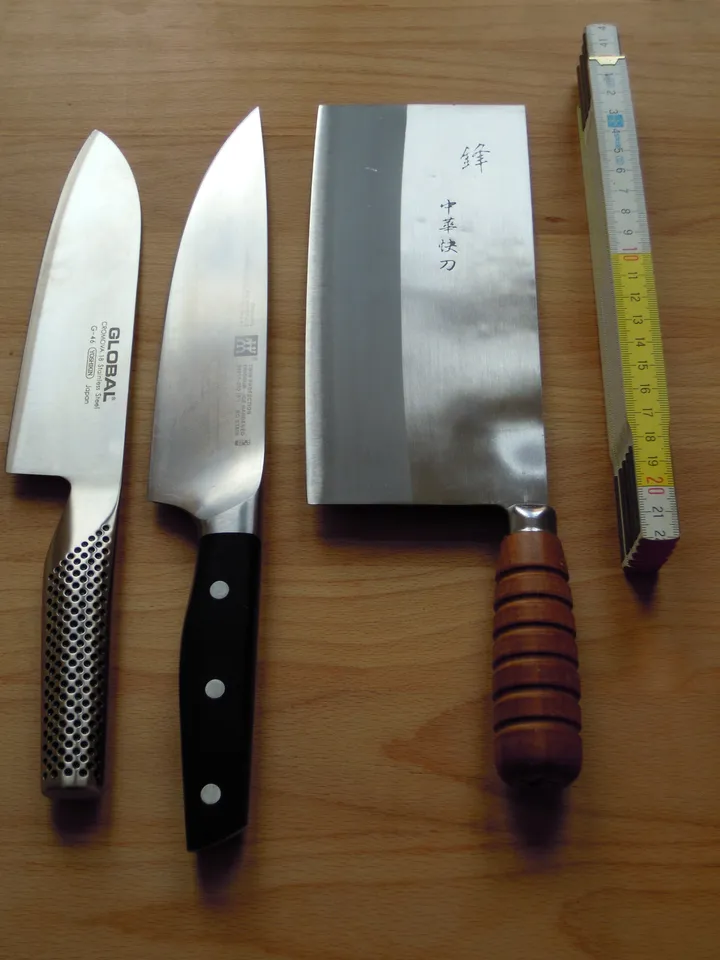
What a chef knife gives you
The Western chef knife is the safe default because it tolerates mixed technique. The curved edge supports rocking cuts, the heel often carries more weight, and the profile feels familiar if you grew up using supermarket knives.
That extra robustness can be useful for dense produce, but it also means more wedging and more fatigue if the knife is thick behind the edge. A full bolster can feel secure, though it may make sharpening the heel more annoying over time.
What a gyuto gives you
A gyuto is the Japanese answer to the chef knife. It is usually thinner, lighter and better suited to push cuts, pull cuts and clean slicing. The tip feels more precise, and a 210mm gyuto often gives a lot of blade without feeling huge.
The trade-off is care. Thin hard edges do not like twisting, bones, frozen food or board scraping. The reward is lower resistance and a more precise feel when your technique is clean.
How to choose
Choose a Western chef knife if you want forgiveness, familiar rocking motion and a sturdier workhorse. Choose a gyuto if you want speed through vegetables, lower cutting pressure and a more precise tip. For most people, 8 inches or 210mm is the balanced first length.
If you cannot decide, buy the knife that feels safer in your hand and spend the saved budget on a good board and a sharpening stone.
Takeaways
- Chef knives favour familiarity and mixed technique.
- Gyutos favour low resistance and precision.
- The best first length is usually 8 inches or 210mm.