
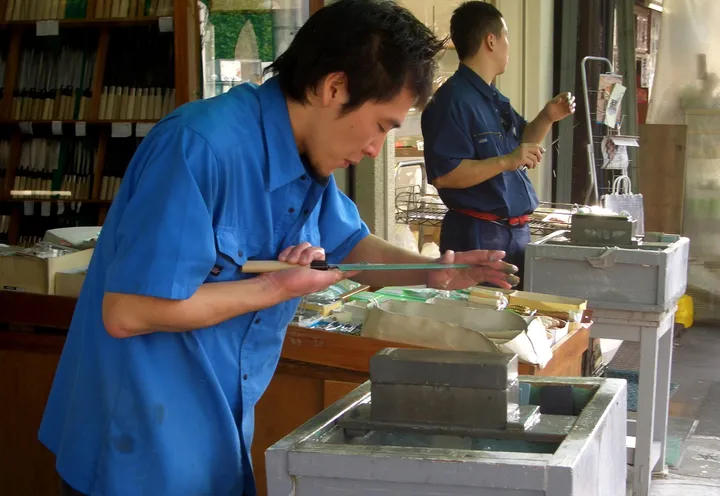
Start with one stone
For routine sharpening of an ordinary double-bevel steel kitchen knife, begin with one medium stone around 1000 grit. A King Deluxe 1000 or Shapton Kuromaku 1000 is a practical starting point. Follow the instructions for the exact stone and secure it so it cannot slide.
This routine is not a repair guide for chips, a method for serrations, or an introduction to specialist single-bevel knives. Those need a different approach.
Hold a consistent angle
Sharpening removes metal until the two sides meet at the cutting edge, or apex. Begin by following the existing edge angle or the maker’s guidance. Keep the angle consistent along the blade rather than chasing an exact number.
Work slowly enough to control the knife. Use the spine’s height above the stone as a repeatable cue, and keep your fingers clear of the edge.
Use pressure deliberately
Apply enough pressure for the abrasive to work, then reduce it as the edge forms. Continuing with heavy pressure can leave more burr to remove. Keep the stone wet as its instructions require.
Check your progress frequently. If a section is not reaching the edge, more pressure across the whole knife may not solve the problem; check the contact and angle at that section.
Form and remove the burr
A burr is a thin lip of metal displaced to the opposite side of the edge. For this beginner routine, look for a small, consistent burr along the length before working the other side. Do not keep grinding to make a large burr.
Finish with controlled, light alternating strokes on the stone. Burr removal takes practice and can be done without a leather strop. A strop is an optional finishing aid, not a way to avoid learning this step.
Check the result
Rinse and dry the knife, then check how it cuts food on a stable board. Look for consistent cutting along the whole edge. A polished bevel by itself does not demonstrate a well-formed edge.
As the stone wears, check its flatness and use a suitable flattening method. Add another grit when you can identify a job the first stone does not do, rather than buying a full progression at the outset.
Takeaways
- Keep the stone stable and follow its preparation instructions.
- Use a consistent angle and reduce pressure as the edge forms.
- Remove the burr on the stone; a strop is optional.
- Chips, serrations and single-bevel knives need different methods.
Retailer links
Check the exact model, seller and delivered price. Marketplace searches can include unrelated items.
My value starting point. Check the standard model and size.
Search Amazon UKAd · Affiliate link. May earn commission.
My convenience starting point for routine sharpening.
Search Amazon UKAd · Affiliate link. May earn commission.